
You found the exact part you need at half the price you expected. The website looks professional, the checkout works and the seller says it is ready to ship. But something feels off.
If you have ever searched “reliable car parts website Australia” because you were not sure whether to trust an online seller, that hesitation is worth listening to.
A good-looking website does not prove there is a real wrecking yard behind it. A .com.au address does not prove the seller actually owns the parts. Even an ABN displayed on a website is not enough by itself.
Before you send hundreds or thousands of dollars for an engine, gearbox, ECU, headlight or body panel, spend five minutes checking who you are actually buying from.
That five minutes can save you a very expensive headache.
Why buying used car parts online needs an extra check
Buying parts online is normal now. It makes sense.
Instead of calling ten wreckers, you can search from home, compare parts, send your VIN, arrange freight and have the component delivered directly to you or your mechanic.
The problem is that the same convenience also makes it easier for dishonest sellers to look legitimate.
Scamwatch warns that scammers create fake websites, copied stores, fake profiles and fake reviews. Common warning signs include unusually low prices, missing ABN or business information, poor terms and conditions and unusual payment requests. Scamwatch also specifically warns that scammers can create professional-looking websites and may even display stolen Australian business details.
So the question is not:
“Does this website look real?”
The better question is:
“Can I independently prove that this is a real business, at a real location, selling a real part, with a process if something goes wrong?”
That is what the checks below are designed to answer.
The 9 checks for a reliable car parts website in Australia
- Check the ABN — and check that the details actually match.
If the seller claims to be an Australian business, look for its ABN and verify it using the official Australian Government ABN Lookup service. ABN Lookup lets you check whether an ABN is active and see public information including the entity name, trading names, state or territory and GST status. Do not stop at seeing the letters “ABN” in the website footer. Search the number yourself. The business name you find should make sense compared with the website, invoice and person asking for payment. If a website calls itself one thing, the payment goes to somebody completely unrelated and the ABN belongs to another company, stop before sending money. An ABN is an important check, but it is not proof by itself because legitimate business details can be copied. - Find the physical address and prove the business is actually there.
A used parts business needs somewhere to dismantle vehicles, store components, inspect stock and dispatch orders. That makes the physical location one of the easiest trust checks you can perform. Search the address independently rather than relying only on the map embedded on the seller’s website. Look at the location, business listing, photographs and available Street View imagery. Scamwatch specifically recommends checking whether the physical location of an online store really exists and whether the business is actually located there. A legitimate online auto parts supplier should normally give you more than a mobile number and a contact form. You should be able to identify who they are, where they operate and how to contact them if your $3,000 engine turns out to be the wrong one. - Make sure the website, business name, phone number and payment details tell the same story.
This check catches a surprising number of problems. Compare the business name on the website with its ABN record, invoice, email domain, physical address and payment details. Small formatting differences are normal. Completely different identities are not. Be particularly careful when a website represents itself as an established Australian company but the seller suddenly asks you to pay a personal account, a completely unrelated PayID or multiple accounts. Scamwatch identifies payment details that do not match the expected person or business as a warning sign. The point is not that every business has to use exactly the same trading name everywhere. The point is that you should be able to follow a logical trail from website to company to payment. - Make them prove that the actual part exists.
This matters more with car parts than almost any other online purchase. A scammer can copy a photograph of a gearbox in seconds. A legitimate dismantler should be able to tell you what is physically sitting in stock. Look for genuine photographs rather than endless generic stock images. Check whether listings include useful identifiers such as the vehicle model, year, part number, engine code, transmission code or stock reference. If the part is expensive, ask the seller to confirm that it is physically available before payment. For something like an engine or gearbox, it is reasonable to ask for an additional photograph, identification code or information about the donor vehicle. The more expensive the component, the less comfortable you should be with “we should have one somewhere”. Central Coast Auto Parts, for example, maintains a searchable live parts inventory so buyers can search stock rather than relying only on a generic enquiry form. The existing NSW wrecker guide uses the same principle: confirm the component is actually in stock before travelling or paying. - Read independent reviews, not only testimonials on the seller’s own website.
A testimonial section is advertising. Treat it that way. Search for reviews outside the company’s own website and read the content rather than simply looking at the star rating. Genuine reviews often mention a particular vehicle, component, employee, delivery experience or problem that was resolved. Fake reviews tend to be vague. Look at recent negative reviews as well. Every established business will eventually have an unhappy customer. What matters is the pattern and how problems are handled. Ten complaints about engines never arriving deserve more attention than one person complaining that a courier arrived a day late. Scamwatch warns that fake shopping websites may use fake reviews to appear legitimate and recommends checking independent reviews elsewhere before buying. If you are buying through a marketplace rather than a dedicated parts business, our guide to avoiding Facebook Marketplace scams when buying used car parts goes into the seller-profile checks in more detail. - Read the warranty and returns policy before you pay.
Do not wait until the engine is sitting in your mechanic’s workshop to ask what the warranty covers. Before payment, establish what warranty is supplied with your particular part, how long it runs, what conditions apply and what happens if the component is incorrect or faulty. Get important promises in writing. Australian Consumer Law is also relevant. The ACCC explains that consumer guarantees apply automatically to qualifying purchases from businesses and cannot simply be removed by a “no refunds” statement. Warranties are additional promises; they do not replace automatic consumer rights. Importantly for used parts, NSW Fair Trading specifically states that second-hand goods sold in trade or commerce are covered by the guarantee of acceptable quality, although their age, price and condition are taken into account. In other words, buying a used component does not mean expecting it to look brand new. But “used” also does not automatically mean the seller has no responsibility whatsoever. - Use a sensible payment method and be suspicious of pressure.
A genuine business wants to get paid. That does not mean it should pressure you into an unusual payment method. Scamwatch recommends checking that an online seller provides secure payment options such as a credit card or PayPal and warns about unusual payment requests and payments to mismatched accounts or multiple PayIDs. Bank transfer itself is not proof of a scam; Australian businesses use transfers every day. The warning sign is the surrounding behaviour. If the name does not match, the seller is rushing you, the account suddenly changes, or you are told that the special price disappears in ten minutes unless you send the money immediately, stop and independently verify the details first. HTTPS and the padlock in your browser are useful security basics, but they tell you that the connection is encrypted. They do not tell you that the person operating the website is trustworthy. - Know the complete delivered price, not just the advertised part price.
A $900 gearbox can stop being a bargain when there is $400 freight attached to it. A door panel may require specialised packaging. An engine sent to another state may need a pallet, commercial delivery address or depot collection. Before paying, confirm the actual part price, GST where applicable, freight cost, delivery destination, expected dispatch time and who carries the cost if the wrong item needs to be returned. NSW Fair Trading’s online-selling guidance emphasises clear delivery terms, accurate product descriptions and explaining what happens if something goes wrong with the order. This is especially important when comparing a local wrecker with an interstate seller. The interstate listing may look cheaper until freight and return freight are added. - Confirm fitment before money changes hands.
The seller can be completely legitimate and you can still have a bad buying experience if you order the wrong part. Cars change within the same model generation. Two vehicles sold as the same year and model can use different engines, transmissions, electrical modules, headlights, suspension components or connectors. A reliable seller should ask questions rather than simply saying, “Yep, that should fit.” Give them enough information to identify the vehicle accurately. If you are buying a high-value mechanical or electronic component, ask the seller to confirm the match in writing before dispatch. For a wider explanation of OEM, aftermarket and used genuine parts, see our guide to wrecker parts vs aftermarket parts.
What information should you give the parts seller?
The better the information you provide, the less room there is for a fitment mistake.
| Information | Why it matters |
|---|---|
| VIN | Usually the best starting point for identifying the exact vehicle specification. |
| Year, make and model | Establishes the basic vehicle family. |
| Build date | Important because manufacturers can change components during a model year. |
| Engine size / engine code | Critical for engines and many mechanical components. |
| Transmission type / code | Necessary when buying gearboxes and driveline components. |
| Body style | Sedan, hatch, wagon, ute and SUV variants can use different parts. |
| OEM / part number | One of the strongest ways to cross-check an exact component where available. |
| Driver or passenger side | Removes confusion with left/right orientation. |
| Photo of your original part | Useful for connectors, brackets, housings and body components. |
For more general fitment advice, the existing guide to choosing the right auto parts for your vehicle covers VINs, OEM numbers and compatibility in more detail.
Buying a used engine or gearbox online? Be stricter
A $60 interior switch and a $4,000 engine should not receive the same level of checking.
If you are buying a large mechanical component, slow down.
First, establish exactly what you are buying. “2.0-litre engine for Mazda” is nowhere near enough. You want the correct engine code, vehicle application and relevant identifiers.
Then ask what information is available about the component. Depending on the part and seller, that might include kilometres, donor-vehicle information, visible identification numbers, condition notes and photographs.
You should also establish the warranty conditions before organising installation. Ask what documentation you need to keep and whether there are installation requirements relevant to the warranty.
Central Coast Auto Parts has dedicated current sections for used engines and used gearboxes and transmissions, and its main site states that used components are inspected and warranty-backed, with Australia-wide freight available.
If an engine is what you are buying, read our Australian used-engine inspection checklist before handing over the money.
The cheapest website is not automatically the best deal
Everybody wants a good price. There is nothing wrong with comparing sellers.
But price should make sense.
If every established Australian seller is asking around the same amount for a particular component and one unknown website suddenly lists five of them for half that amount, find out why before assuming you discovered the deal of the year.
Sometimes there is a perfectly reasonable explanation. The seller may be clearing stock. The part may have cosmetic damage. It may have higher kilometres. It may be incomplete.
But an unusually low price is also one of the warning signs identified by Scamwatch for fake online stores.
Compare the total deal: the actual part, condition, warranty, freight, return position and whether you can reach somebody if there is a problem.
Saving $150 on the purchase price is not a saving if you end up with a component that does not fit and nobody answers the phone.
A .com.au website is a positive sign — but not proof
This catches people because the website looks Australian.
Australian phone number. Australian prices. Australian-looking business name. .com.au domain. Maybe an ABN at the bottom.
Still check it.
Scamwatch warns that sophisticated fake sites can impersonate real businesses and that scammers may use Australian-looking websites and stolen business details.
That is why the checks work best together.
A verified ABN is useful.
A real address is useful.
Independent reviews are useful.
A working phone number is useful.
Real stock is useful.
Matching payment details are useful.
A written warranty is useful.
When all of those pieces point to the same established business, you have something much stronger than a nice-looking homepage.
Business seller versus private seller: know the difference
There is another important distinction when buying used car parts online.
Buying from an established business is not the same as buying a component from somebody dismantling an old car in their driveway.
The Australian Consumer Law provides automatic consumer guarantees for qualifying goods purchased from businesses. The ACCC explains that these guarantees include requirements around acceptable quality, matching descriptions and fitness for disclosed purposes in applicable circumstances.
NSW Fair Trading further confirms that the acceptable-quality guarantee can apply to second-hand goods sold in trade or commerce, with the part’s age, price and condition taken into consideration.
A private marketplace transaction can leave you in a very different position.
That does not mean you should never buy privately. Plenty of legitimate private sellers have perfectly good parts.
It means the price should reflect the extra risk, and you should understand who you are dealing with before paying.
Should a legitimate parts website provide a receipt?
You should expect proper transaction records from a business.
In NSW, Fair Trading says businesses must provide proof of transaction for consumer purchases of $75 or more, excluding GST, and must provide one for a smaller transaction if the consumer requests it within the required period. The proof of transaction identifies things such as the supplier, transaction date, goods or services and price.
For an expensive used component, keep everything.
Keep the invoice.
Keep the listing.
Keep the warranty information.
Keep the emails or messages confirming fitment.
Keep the freight tracking.
And if a seller confirmed a particular OEM number, engine code or compatibility condition, keep that too.
It is far easier to solve a dispute when there is a written record of what was actually agreed.
What if the used part arrives and does not match the description?
Contact the seller first and explain the problem clearly.
Send photographs and provide the invoice, order number and any earlier messages showing what you ordered.
If the transaction falls under Australian Consumer Law and the product does not meet the applicable consumer guarantees, remedies may be available depending on the nature of the problem. The ACCC explains that remedies can include repair, replacement or refund in relevant circumstances.
Do not confuse the seller’s voluntary warranty with your automatic rights. The ACCC makes clear that a warranty does not eliminate consumer guarantee rights.
The exact remedy depends on the facts, so treat this as general information rather than individual legal advice.
What if the part never arrives?
Start by contacting the seller and asking for shipment confirmation and tracking.
If something genuinely looks wrong, act quickly rather than spending three weeks sending messages to an account that has disappeared.
Contact the financial institution or payment provider used for the transaction and ask what options are available for that specific payment.
If you believe you have encountered a scam, use the official Scamwatch buying and selling scams information and report what happened.
If the issue is a consumer dispute with a NSW business rather than an outright scam, NSW Fair Trading advises consumers to try resolving the matter with the business first. If it cannot be resolved, Fair Trading may assist with the complaint process. You can also access the official NSW Fair Trading complaint form.
Quick comparison: trustworthy site versus risky site
| More reassuring | Worth investigating |
|---|---|
| ABN can be independently verified | No ABN despite claiming to be an Australian business |
| Business details match the seller and invoice | Payment requested to an unrelated name |
| Real physical business address | Address missing or does not make sense |
| Searchable or confirmable actual inventory | Generic “we have everything” claims |
| Detailed photographs and identifiers | Only generic or copied-looking images |
| Independent customer reviews | Only perfect testimonials on its own site |
| Written warranty information | “No warranty, no returns” with no explanation |
| Clear freight and delivery terms | Seller avoids discussing delivery |
| Secure, normal payment options | Strange payment instructions or pressure |
| Seller asks for VIN/build information | “It fits everything” |
| You can reach a real person | Only messages and no verifiable contact details |
No single green flag proves a business is genuine, and no single odd detail automatically makes it fraudulent. Look at the complete picture.
What a reliable Australian used-parts supplier should make easy
A good supplier should remove uncertainty rather than create more of it.
You should be able to work out who the business is.
You should know where it is located.
You should be able to contact somebody.
You should know whether the part is available.
You should be able to provide your vehicle details and get a fitment check.
You should know how the part will get to you.
And before payment, you should know what happens if there is a genuine problem.
That is the standard worth looking for whether you are buying a $100 mirror or a $5,000 drivetrain component.
For a wider overview of online parts shopping, read our Auto Parts Online Australia buying guide and our more specific checklist for buying auto parts online in Australia.
Buying from Central Coast Auto Parts
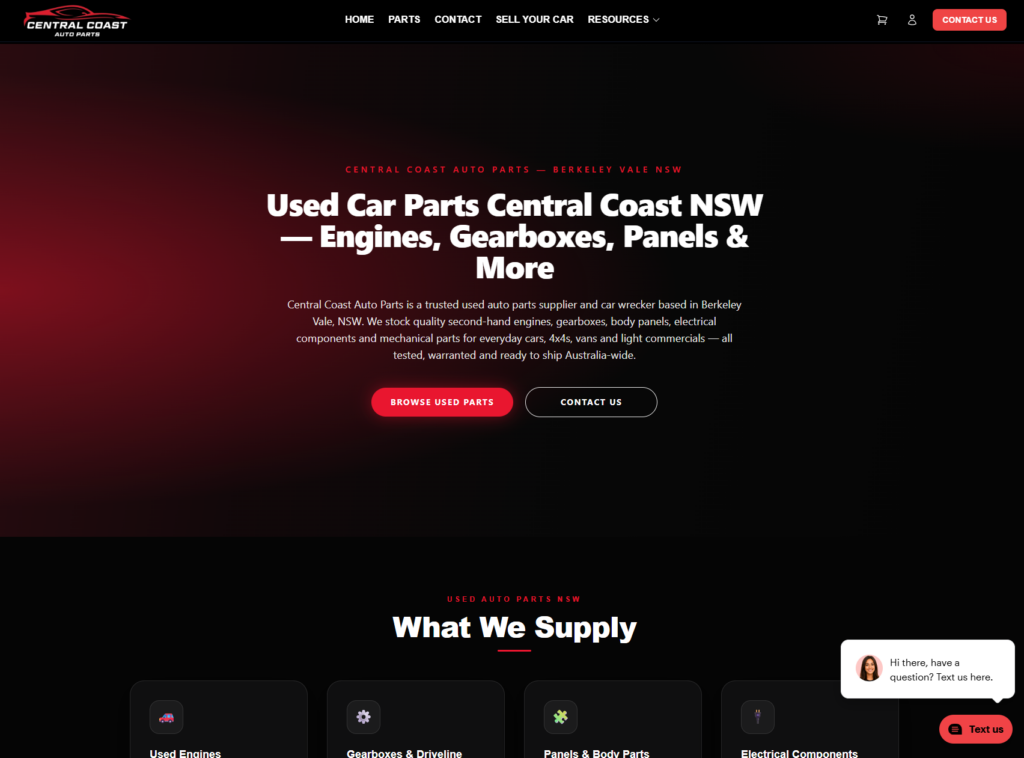
Central Coast Auto Parts is a physical dismantling yard and used auto parts supplier based at 23 Hereford Street, Berkeley Vale NSW 2261. The current website lists engines, gearboxes, body panels, electrical components, suspension and other mechanical parts, along with Australia-wide delivery. It also publishes its phone number, email address, trading hours and NSW motor dealer licence number.
You can read more about Central Coast Auto Parts, browse the current used parts inventory or contact the parts team directly with your VIN, year, make, model and the part you need.
The current site states that its used parts are inspected and supplied with warranty coverage, with specific warranty details available from the team.
That is the important difference: you should know who is selling you the component, where it came from and who you can speak to if you need help.
Frequently asked questions
How do I know if a car parts website is legit in Australia?
Check the seller’s ABN through the official ABN Lookup service, confirm the physical business address, look for independent reviews and compare the business name with the invoice and payment details. A legitimate seller should also provide clear contact information, warranty or returns information and be able to confirm that the part is actually in stock.
Is it safe to buy used car parts online in Australia?
Yes, buying used car parts online can be safe when you use an established seller and confirm the exact part before payment. Check the business identity, reviews, warranty, delivery terms and fitment. For expensive items such as engines and gearboxes, ask for additional identification and condition information before purchasing.
What is the safest way to pay for used car parts online?
Use a normal, secure payment method offered by the legitimate business and verify who is receiving the money. Scamwatch recommends secure payment services such as credit cards or PayPal and warns buyers about unusual payment requests, multiple accounts and payment details that do not match the expected seller.
Do Australian used car parts sellers have to provide a warranty?
A seller’s written warranty and your Australian Consumer Law rights are different things. Consumer guarantees can automatically apply to qualifying purchases from businesses. NSW Fair Trading states that second-hand goods sold in trade or commerce are covered by the acceptable-quality guarantee, although age, price and condition are considered.
Can I return a used car part if it does not fit?
It depends on why it does not fit, what the seller represented, the applicable consumer guarantees and the seller’s change-of-mind policy. Avoid the problem by giving the seller your VIN, build date, engine or transmission code and OEM number where available, and ask them to confirm compatibility before payment.
What should I do if a used car part never arrives?
Contact the seller immediately and request tracking or proof of dispatch. Keep your invoice, listing and messages. If you suspect fraud, contact your payment provider or bank promptly and report the matter through Scamwatch. For an unresolved NSW consumer dispute with a business, NSW Fair Trading may also be able to assist.
The short version
Do not judge a car parts website by the homepage.
Check the ABN. Check the physical address. Check independent reviews. Confirm the exact part exists. Give the seller enough vehicle information to verify fitment. Read the warranty and returns terms. Make sure the payment details make sense.
Five minutes of checking is cheap compared with chasing a missing $3,000 engine.
Need a part? Search the Central Coast Auto Parts live inventory by your vehicle details, or contact the Berkeley Vale team if you want fitment confirmed before you order.
Internal-link plan for this article
I’d use these links in WordPress exactly around the relevant anchor text:
| Anchor text | Destination |
|---|---|
| live parts inventory | Products page |
| used engines | Engines page |
| used gearboxes and transmissions | Gearboxes page |
| about Central Coast Auto Parts | About page |
| contact the parts team | Contact page |
| Facebook Marketplace scams | Marketplace scam article |
| Auto Parts Online Australia | Online parts guide |
| buying auto parts online checklist | Online checklist article |
| wrecker parts vs aftermarket parts | Wreckers vs aftermarket article |
| used-engine inspection checklist | Used engine inspection article |
For incoming internal links, I would also edit the existing Facebook Marketplace scams article, the Auto Parts Online Australia article, and the “Auto Wreckers Near Me” article and add a contextual link back to this new post. That will help Google understand that this is the site’s main trust/safe-buying pillar rather than another competing online-parts article.
External authority links to keep
| Anchor | Authority |
|---|---|
| ABN Lookup | Australian Business Register ABN Lookup |
| Scamwatch buying and selling scams | Scamwatch |
| Australian Consumer Law / consumer guarantees | ACCC consumer rights and guarantees |
| Second-hand goods / consumer guarantees | NSW Fair Trading consumer guarantees |
| NSW consumer complaint | NSW Fair Trading complaint form |
I checked these against the live/current pages rather than relying on old URLs. The main Central Coast Auto Parts site currently confirms the Berkeley Vale address, Australia-wide delivery, parts categories, contact details and warranty-backed used parts.